
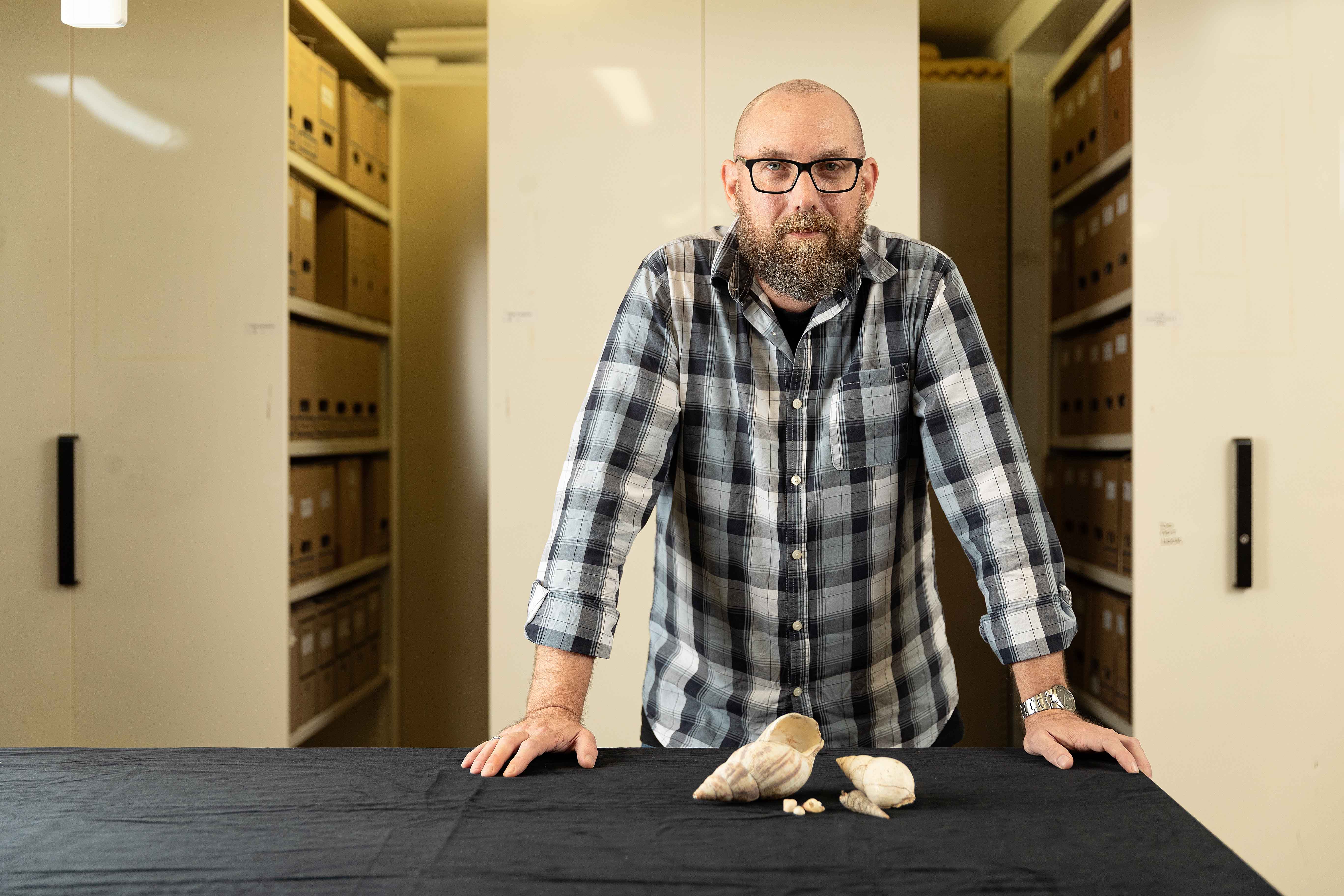
Associate Professor Patrick Faulkner is investigating how climate change and shifting sea levels from 24,000 to 1,000 years ago influenced human behaviour and migratory patterns on the southern coast of Sri Lanka.
His research, which featured in a 2024 journal article in Scientific Reports, focuses on Pathirajawela on the southern coast of Sri Lanka, which is a largely untapped archaeological resource.
By studying shell fragments, he can interpret changes in human behaviour over time, such as the shifts from economic use to ritual or symbolic use of certain shells. He also analyses the composition and variety of shell species to understand past diets and how people used those resources.
Associate Professor Faulkner holds a unique expertise in this area having spent the last 12 years working internationally on research projects in eastern Africa, Papua New Guinea, Oman and Jordan, and more recently in Sri Lanka as part of his ARC Future Fellowship.
“Working on shells allows me to understand the nature of human-environmental interactions on the coast (and other aquatic environments), or how people engaged with marine environments from inland locations, in a way that adds a different dimension to other forms of archaeological evidence,” said Associate Professor Faulkner.
Scientists know sea levels began to rise in Sri Lanka 24,000 years ago by studying ancient geological and biological evidence, such as marine fossils and sediment cores from locations that were once underwater. Techniques such as radiocarbon dating have been used to reconstruct past sea levels and identifying indicators of past shorelines, now found inland.
The better we understand these processes in the past, the better we are at putting mechanisms in place to cope with them into the future.
Associate Professor Patrick Faulkner
Archaeology of ancient shells
Associate Professor Faulkner’s work in Sri Lanka indicates that people completely shifted their food and resource strategies in response to warmer temperatures and rising sea levels.
As sea levels rose, new coastal ecosystems formed, prompting a shift in human activity and settlement in coastal zones. 5,000 years ago, settlers took advantage of resource-rich estuarine ecosystems for foraging including clams, oysters and mussels, making the coast an attractive place to live, despite the rising water.
“We’ve been able to show that people responded to changes in the physical environment from 24,000 years ago, adapting their technologies to accommodate these changes, and incorporating new resources into their diet as sea levels reached (and slightly exceeded) their current levels around 5,000 years ago.
Much discussion has been generated over the likely natural or human origin of coastal shell deposits on the southern coast of Sri Lanka, outlining a way forward in understanding human engagement with near shore environments in the area, as well as implications for managing cultural heritage and likely future environmental changes impacting this coastline.
Preservation of coastal ecosystems
While understanding past human behaviour through the archaeological lens of Sri Lanka is important in itself, Associate Professor Faulkner suggests this data will add significantly to ideas of current and future coastal occupation across the globe.
“Our results will help heritage managers in Sri Lanka understand what sites are, where they are, the kinds of impacts they are currently being subjected to, and how those impacts can be mitigated into the future.
As an island with a low-lying coast, Sri Lanka is directly threatened by sea level rise which can inundate coastal lands.
Mapping and modelling across the area will provide information to wildlife and conservation staff to assist them in managing ecosystems more effectively now, as well as into the future, as the climate continues to change and affect areas adjacent to the coast.
“The better we understand these processes in the past, the better we are at putting mechanisms in place to cope with them into the future.”
Manual Name : Associate Professor Patrick Faulkner
Manual Description : Faculty of Arts and Social Sciences
Manual Address :
Manual Addition Info Title :
Manual Addition Info Content :
Profile image : /content/dam/corporate/images/chau-chak-wing-museum-restricted-images/whats-on/talks-and-events/2021/patrick-faulkner.jpg
Manual Type : profile
_blank
Auto Type : contact
Auto Addition Title :
Auto Addition Content :
Auto Name : true
Auto Position : true
Auto Profile image :
Auto Phone Number : false
Auto Mobile Number : true
Auto Email Address : true
Auto Address : false
UUID :