
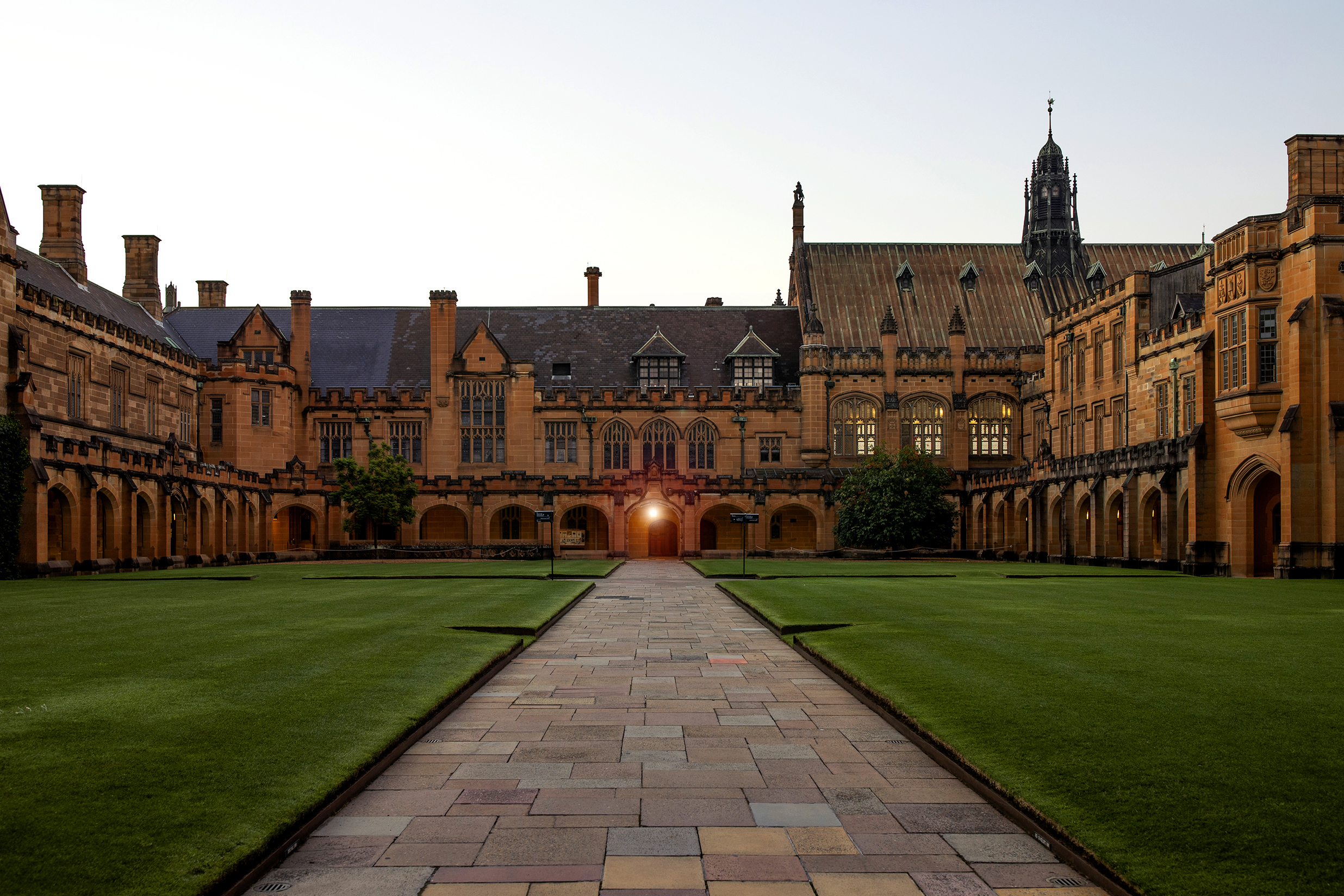
Bachelor of Commerce and Bachelor of Laws
What you’ll study: 2027
Students commencing in 2027 will study the Bachelor of Commerce concurrently with Bachelor of Laws foundational core requirements. Bachelor of Commerce requirements include core foundational units of study in commerce:
- Fundamentals of Professional Success;
- Accounting and Finance for Business Decisions;
- Problem Solving in Business and Society; and
- Data Analytics in Business.
You will then deepen your expertise through a major drawn from the Bachelor of Commerce, culminating in an advanced capstone experience that applies your learning. You can choose majors or minors from study areas such as Accounting, Governance and Regulation, Banking, Business Analytics, Business Law, Digital Business, Finance, Global Business, Human Resource Management and Employment Relations, Innovation and Entrepreneurship, Management and Leadership, and Marketing.
You will also select units of study from the Open Learning Environment and elective units of study as required from the Bachelor of Commerce or the Shared Pool (Table S).
After meeting the requirements of the Bachelor of Commerce, you will progress to the Bachelor of Laws, completing a number of core and elective units of study from the Sydney Law School Undergraduate Table in a specific sequence.
The elective units of study will include at least one jurisprudence elective, and in your final year of the Bachelor of Laws you will have the option to complete advanced coursework and an honours thesis.
Throughout the degree, students have opportunities to develop industry-relevant capabilities through integrated learning experiences, professional development activities and engagement with industry, preparing them for a wide range of business and professional careers.
Available majors are listed below.
Explore your options
Browse the various subject areas you can choose within this degree.
2027 tuition fees
This is the indicative annual student contribution amount (per calendar year), based on a full-time study load of 48 credit points. The degree requires 240 credit points in total.
Important fee information
This course offers a Commonwealth Supported Place (CSP). That means you don’t pay the full course fee. The Australian Government pays part of the cost, and you pay the remaining amount, called the student contribution amount.
You do not need to apply separately for a CSP. All eligible students will be considered when you apply for admission via UAC.
Your Fees Explained
This is an estimate
The indicative fees displayed are an estimate only. The estimate is for a Commonwealth supported place for 1 year of full-time study, which is usually 48 credit points (also known as 1.0 EFTSL).
The actual fees you will pay in your first calendar year will depend on many factors including:
1. the calendar year in which you commence studying your current course
2. the intake in which you commence your studies
3. whether your course is eligible for special rates for particular units of study
4. the specific units of study in which you enrol; and
5. the student contribution bands under which each unit of study sits.
The most recently published calendar year of fees payable for a specific unit of study are available here. If you have any questions, you can submit an enquiry.
How the estimate has been calculated
Generally, the estimate displayed on the course page is usually calculated based on one of two methods:
1. if a course has the effective equivalent of at least 10 full-time students enrolled, the fee estimate is based on the most recent data showing the average amount those students actually paid; or
2. for new courses or those with fewer students (where we don’t have enough data), the estimate is based on the typical cost of studying full-time in the main subject area of the course.
Additional costs, fees and incidentals
For most courses, there are other costs in addition to the tuition and/or student contribution amount, such as the Student Services Amenities Fee. Some are significant and can include course-specific materials, tools, protected clothing and equipment. Other costs may include application fees and credit card surcharges.
Entry requirements
Qualifications
Mandatory for course entry
To be eligible for admission into one of our undergraduate degrees, you need to have completed a recognised qualification and meet the required entry score.
Find your qualification in the qualification dropdown below (organised by country). If your qualification isn’t listed, you can find the full list on the recognised qualifications page.
International qualifications
For qualifications awarded outside Australia, equivalencies and entry requirements are determined based on the country, institution, and qualification.
Find your qualification
99.5
Selection rank
ATAR + adjustment factors
All scores listed are a guide for admission and subject to change.
Prerequisites
There are no prerequisites for this course.
Assumed knowledge
You are expected to have studied the following subjects in high school to succeed in this course:
- Mathematics Standard or higher (depending on majors or units of study chosen)
Other assumed knowledge depends on majors or units of study chosen.
English Language Requirements
Mandatory for course entry
How to apply
All domestic students need to apply through the Universities Admissions Centre (UAC).
Step 1:Documents you'll need
If you're an Australian Year 12 student UAC can usually obtain your results and ATAR from the relevant state education authorities.
You may be required to upload other documents depending on your circumstances and course preferences.
For a full list of documents required, visit the UAC website.
Step 2:Key dates
Applying for Semester 1 (February)?
- The University makes most of its Semester 1 offers through UAC's December Round 2.
- It does not participate in every UAC offer round and makes limited or no offers before December Round 2.
- Application close for December Round 2: Applications typically close in late November.
- Offers released for December Round 2: Offers are typically released in late December.
- After December Round 2, some courses may be full and stop making offers.
- Course vacancies will be available on the UAC website after January Round 1 offers are released.
Applying for Semester 2 (August)?
The University typically participates in selected UAC offer rounds between May and July. Offer rounds and dates may vary each year.
We strongly encourage you to visit the UAC website for a comprehensive list of key dates, including December Round 2 offers.
Step 3:Apply via UAC
To maximise your chances of receiving an offer from the University of Sydney, make sure to list your most desired degree at the University of Sydney as your first preference in your UAC application.
Step 4:After you apply
When the outcome of your application is available, you’ll receive an email from UAC. You will then receive an email from us with instructions on how to accept your offer.