
A pair of Sydney PhD students helped sharpen the view of humanity’s most powerful space observatory – without leaving Earth. As an indelible reminder of this thrilling result, Louis Desdoigts, now a postdoctoral researcher at Leiden in the Netherlands, and his colleague Max Charles, had tattoos of the instrument their work has repaired inked on their arms.
This remarkable technical breakthrough saw University of Sydney researchers develop a software enhancement that carefully calibrated images made by NASA’s multibillion-dollar James Webb Space Telescope (JWST), enhancing the crisp performance of one of its vital scientific instruments – all without the need for any hardware change.
The achievement builds on the only piece of Australian-designed hardware on the JWST – the Aperture Masking Interferometer (AMI) – created by Professor Peter Tuthill from the University of Sydney’s School of Physics and Sydney Institute for Astronomy. The AMI lets astronomers take ultra-high-resolution images of stars and exoplanets by combining light from multiple patches on the telescope’s main mirror, a technique known as interferometry.
Dr Louis Desdoigts (left), now a postdoc at Leiden University in the Netherlands, and Max Charles, who is completing his doctorate at the University of Sydney.
50
automatic
LinkIn almost every respect JWST exceeds expectations in performance, and has delivered wide and sharp images of the depths of space. In one respect, however, it became apparent thatAMI’s performance at the highest resolutions was being degraded by subtle electronic distortions in its infrared camera detector, injecting a tiny level offuzziness into the images that limited the detection of the faintest planets.
Applying the most modern tools from machine learning,PhD students Louis Desdoigts and Max Charles from Professor Tuthill’s group, also working with Associate Professor Benjamin Pope (at Macquarie University), created a data-driven, software-only calibration system to for the first time correct a fundamental electronic process that affects almost all infrared space telescopes, not just JWST, and can now enhance their resolution.
Their system, called AMIGO (Aperture Masking Interferometry Generative Observations), uses advanced simulations and neural networks to model how the telescope’s optics and electronics behave in space. By understanding how electrical charge bleeds over into neighbouring pixels,known as the brighter-fatter effect, the team developed algorithms that “de-blurred” the images and improved AMI’s sensitivity.
“JWST is a beautiful telescope, and it’s a privilege to sharpen it even further in code and with our aperture masking technology,” Professor Tuthill said. “It’s a brilliant example of how Australian innovation can make a global impact in space science.”
Sharpening the JWST images: top row is raw data images of galaxy NGC 1068, Jupiter’s moon Io and Wolf-Rayet star 137 (or WR 137). The bottom row shows sharpened or ‘deblurred’ images after being processed by the pipeline developed by Louis Desdoigts and Max Charles. Source: Max Charles/University of Sydney
50
automatic
LinkThe enhancement has produced spectacular results. With AMIGO, the James Webb Space Telescope has achieved sharper-than-ever detections of faint celestial objects – including the direct imaging of a dim exoplanet and a red-brown dwarf orbiting the nearby star HD 206893, about 133 light years from Earth
A companion study led by Max Charles, a PhD student at Sydney, has demonstrated AMI’s renewed capabilities by capturing high-resolution images of a black hole jet, the volcanic surface of one of Jupiter’s moons (Io) and the dusty stellar winds of WR 137 – pushing the boundaries of JWST’s capabilities.
“This work sharpens JWST’s world-beating vision even further,” Dr Desdoigts said. “It’s incredibly rewarding to see our software extend the telescope’s scientific reach – and to know it was possible without ever leaving the lab. We are very grateful for all the support the JWST head office in Baltimore have given to this project, which was vital to its success.”
Dr Desdoigts has now landed a prestigious postdoctoral research position at Leiden University in the Netherlands.
Both studies have been published on the pre-press server arXiv. Dr Desdoigts paper has been peer-reviewed and will shortly be published in the Publications of the Astronomical Society of Australia. We have published this release to coincide with the latest round of James Webb Space Telescope General Observer, Survey and Archival Research programs.
Associate Professor Benjamin Pope, who will present on these findings at SXSW Sydney on Friday, said the research team was keen to get the new code into the hands of researchers working on JWST as soon as possible.
Research
Desdoigts, L. et al ‘AMIGO: a data-driven calibration of the JWST interferometer’ arXiv:2510.09806 Under peer-review at Publications of the Astronomical Society of Australia.
Charles, M. et al ‘Image reconstruction with the JWST interferometer’. arXiv:2510.10924 (awaiting peer-reviewed)
Declaration
The researchers declare no competing interests. Funding was received from the Australian Research Council, Big Questions Institute, Natural Sciences and Engineering Research Council of Canada, National Research Council Canada, National Science Foundation (USA) and NASA.
Editorial note
An earlier version of this article made a comparison between the very subtle effects in otherwise excellent JWST images, effects which are common to infrared telescopes in general and only limit their performance at the very highest resolutions, and the serious focus issue that affected the Hubble Space Telescope after its launch. This comparison was misleading, and we affirm that there is no doubt about the focus, or optical or electronic quality of JWST.
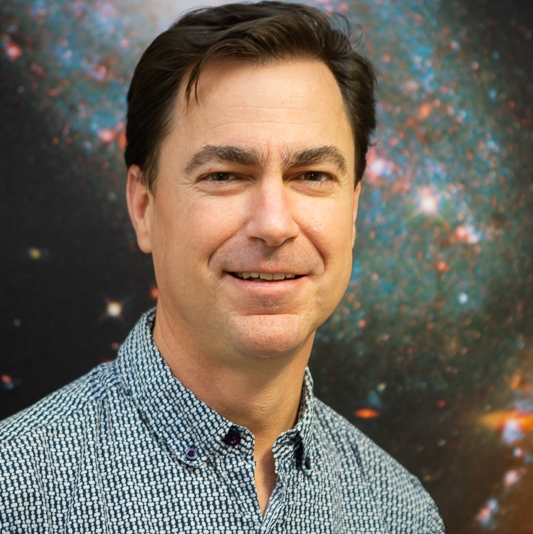
Manual Name : Professor Peter Tuthill
Manual Description : Senior author
Manual Address :
Manual Addition Info Title :
Manual Addition Info Content :
Profile image : /content/dam/corporate/images/news-and-opinion/news/2025/october/professor-peter-tuthill---university-of-sydney.jpg
Manual Type : profile
_self
Auto Type : contact
Auto Addition Title :
Auto Addition Content :
Auto Name : true
Auto Position : true
Auto Profile image :
Auto Phone Number : false
Auto Mobile Number : true
Auto Email Address : true
Auto Address : false
UUID :
Manual Name : Media contact
Manual Description : Marcus Strom, Science Media Adviser
Manual Address :
Manual Addition Info Title :
Manual Addition Info Content :
Profile image :
Manual Type : contact
_self
Auto Type : contact
Auto Addition Title :
Auto Addition Content :
Auto Name : true
Auto Position : true
Auto Profile image :
Auto Phone Number : false
Auto Mobile Number : true
Auto Email Address : true
Auto Address : false
UUID :