
A team of students and their academic supervisor at the University of Sydney have produced the first high-resolution, ground-based map of natural gamma radiation across metropolitan Sydney. The results confirm that everyday radiation levels are completely safe and largely determined by the rocks beneath our feet.
The study, published in the Journal of Environmental Radioactivity, was led by Dr Laura Manenti from the School of Physics and carried out by a team including a second-year physics undergraduate, an Honours student and a PhD candidate.
“This project is a perfect example of how students at Sydney gain genuine, hands-on research experience,” Dr Manenti said. “They weren’t just assisting – they were designing measurements, collecting data across the city, analysing it and communicating the results.”
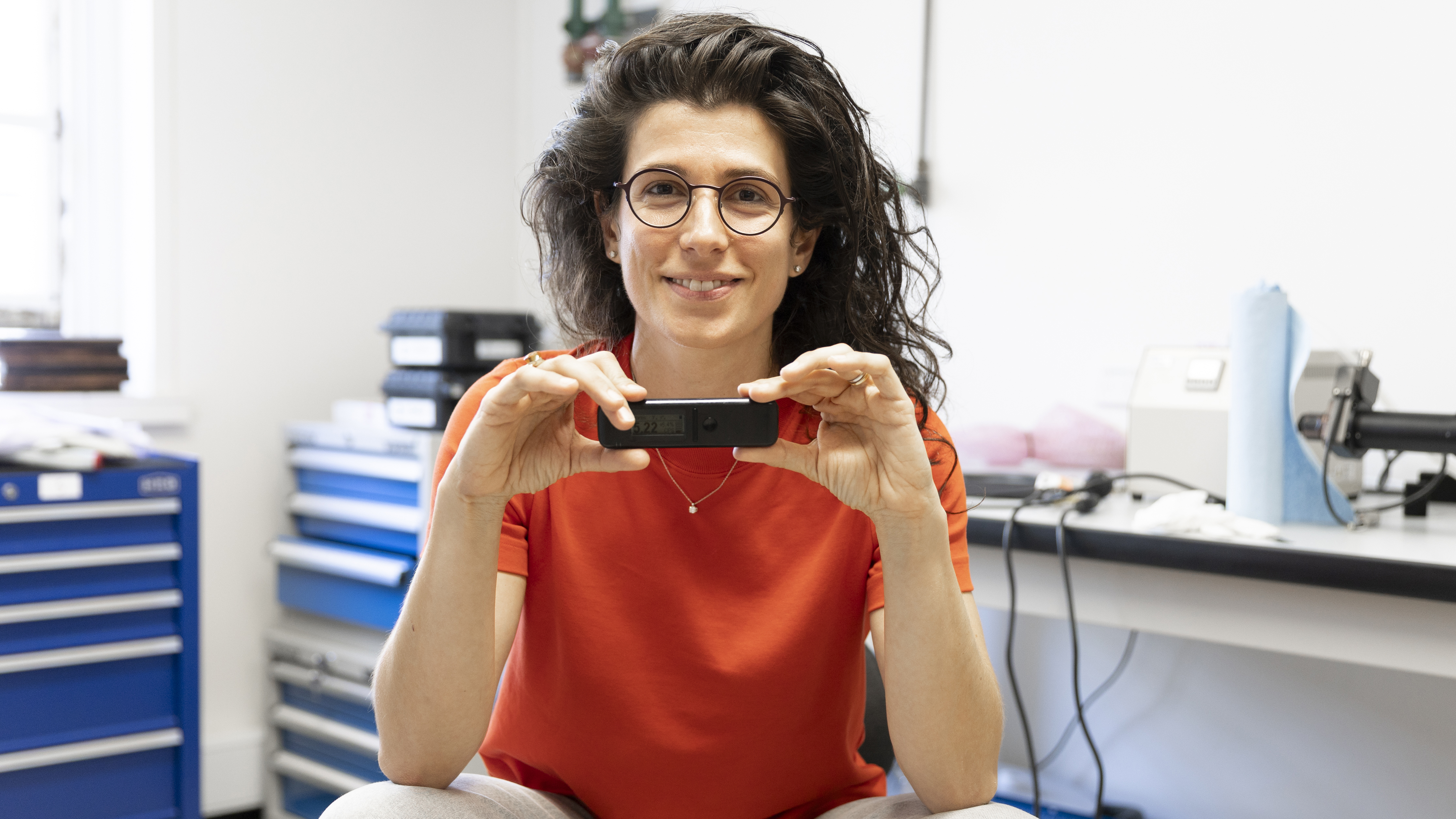
Dr Laura Manenti holding one of the simple gamma radiation detectors used in the study. Photo: Stefanie Zingsheim
50
automatic
LinkUsing portable, low-cost gamma-ray spectrometers – devices small enough to carry in your pocket – the team collected radiation measurements in parks, open spaces and even aboard ferries on Sydney Harbour.
The lead author on the paper is University of Sydney PhD candidate Tengiz Ibrayev, who worked alongside Honours student Matilda Lawton and other contributors to survey a 10 square kilometre area of the city. Co-author Artem Knyazev, a second-year student from NYU Abu Dhabi in Sydney on summer exchange, was also part of the team.
“People often hear the word ‘radioactivity’ and think it’s something dangerous,” Mr Ibrayev said. “But the reality is that radioactivity is a natural part of our environment. It’s in the rocks, the soil – even in food and in our own bodies.”
The researchers found that the average terrestrial (ground-based) radiation dose in Sydney is about 0.24 millisieverts per year, with a further 0.17 millisieverts coming from cosmic radiation from space. These values are generally below typical global background levels, which average around 2.4 millisieverts per year. (A sievert is a measure of radiation that can be absorbed by the body.)
In short, Sydney’s natural radiation levels are normal, harmless, and nothing to worry about.
“The gamma rays won’t be producing any Incredible Hulks anytime soon,” Dr Manenti said.
The research team (left to right, top row first): Alex Herscovics (Honours), Jonathan Zhu (undergrad), Tengiz Ibrayev (PhD student), Danish Khan (PhD student). Second row: Komal Kataruka (undergrad), Laura Manenti (head of group), Matilda Lawton (Honours).
50
automatic
LinkGeological variation
What is striking is how clearly the radiation patterns mirror Sydney’s geology. Areas underlain by Hawkesbury sandstone and Ashfield shale (Surry Hills, Glebe and into the Inner West) tend to show slightly higher natural radiation than regions with more recently deposited layers – known as quaternary sediments – (such as Kensington, Centennial Park and parts of Paddington); though all remain safely within natural background ranges.
As the authors put it in the paper, “geological composition largely determines the spatial pattern of natural radioactivity in Sydney”.
To help explain these ideas to a broader audience, the team collaborated with illustrator Francesca Cosanti on a comic-style cartoon that accompanies the study. The cartoon walks readers through questions many people ask – from “Is my coffee radioactive?” to “Is space trying to kill me?” – and answers them with clear science. (Yes, your coffee is slightly radioactive. No, it’s not dangerous.)
The research has implications beyond Sydney. Australia has lacked city-scale radiation maps based on direct, ground-level measurements. Existing national maps rely largely on airborne surveys, which are too coarse to capture variations within urban environments.
Co-author and physics honours (2026) student Matilda Lawton in Dr Manenti's laboratory.
50
automatic
LinkBy using portable, low-cost instruments and a straightforward methodology, the Sydney study establishes what the authors describe as a “reproducible, low-cost approach that addresses a relevant data gap”.
“This is something that could be repeated in other cities, in Australia and around the world,” Dr Manenti said. “It also opens the door to future citizen-science projects, where communities themselves can help map and understand their local environment.”
For now, Sydneysiders can rest easy: the city’s natural radioactivity is simply part of the bedrock under our feet and poses no danger.
Research
Ibrayev, T. et al ‘Sydney’s first terrestrial gamma-radiation map’ (Journal of Environmental Radioactivity 2026). DOI: 10.1016/j.jenvrad.2026.107909
Declaration
The authors declare no competing interests. The authors acknowledge support from the Australian Research Council Centre of Excellence for Dark Matter Particle Physics.
Manual Name : Dr Laura Manenti
Manual Description : Dark Matter Research Lecturer
Manual Address :
Manual Addition Info Title :
Manual Addition Info Content :
Profile image : /content/dam/corporate/images/news-and-opinion/news/2026/february/dr-laura-manenti-holding-a-radiocode-gamma-radiation-detector-in-her-lab.-photo-fiona-wolf-usyd-crop.jpg
Manual Type : profile
_self
Auto Type : contact
Auto Addition Title :
Auto Addition Content :
Auto Name : true
Auto Position : true
Auto Profile image :
Auto Phone Number : false
Auto Mobile Number : true
Auto Email Address : true
Auto Address : false
UUID :
Manual Name : Media enquiries
Manual Description : Marcus Strom, Science Media Adviser
Manual Address :
Manual Addition Info Title :
Manual Addition Info Content :
Profile image :
Manual Type : contact
_self
Auto Type : contact
Auto Addition Title :
Auto Addition Content :
Auto Name : true
Auto Position : true
Auto Profile image :
Auto Phone Number : false
Auto Mobile Number : true
Auto Email Address : true
Auto Address : false
UUID :