
Inside the University of Sydney’s Faculty of Engineering, a team of researchers are solving a challenge: how do you build machines to process native Australian grains that are smaller and more delicate than their European counterparts?
The answer is being developed by Professor Salah Sukkarieh and his engineering team, thanks to a transformative gift from the Ian & Shirley Norman Foundation — the Foundation’s first to the University. Designed in close collaboration with Gamilaraay and Yuwalaraay stakeholders, the donation is enabling the creation of Australia’s first commercial-grade native grain threshing and cleaning systems, built in partnership with Indigenous leaders and communities.
“Most of the threshing technology used in agriculture today is designed for European crops which are not suitable for native grains,” explains Professor Sukkarieh. “So, we’ve set out to create something from the ground up working with Gamilaraay and Yuwalaraay stakeholders who are sharing their cultural knowledge.”
Small grains, big potential
Native grains like Native Millet and Mitchell Grass hold immense potential for sustainable farming and land regeneration and are culturally significant to many Indigenous communities who traditionally hand-thresh the grains. However, the machinery needed to process them simply doesn’t exist — until now.
Professor Sukkarieh’s team is working on four integrated solutions. First, they’re building technology that fits within the existing Narrabri research site, a facility already used by Indigenous custodians for growing native grains. Second, they’re developing data-enabled systems to not only process the grain but collect insights that can support ongoing agricultural research. Third, they’re designing a mobile, trailer-based unit that can be transported to remote communities. And fourth, they’re working toward an open-access model so Indigenous communities can build and adapt the technology themselves, with full ownership over how it’s used.
“This is about creating engineering systems that work in real environments,” says Professor Sukkarieh. “But it’s also about making sure those systems are scalable, accessible, and culturally appropriate — especially as we begin to collaborate with remote communities.”
Co-design at the centre of innovation
To do that responsibly, the team is moving with care, with community co-design being intentionally paced.
“We didn’t want to just build something and hand it over,” Professor Sukkarieh says. “The goal is to co-design the next stages directly with community, and that takes time, relationships, and the right people in the room.”
For the Ian & Shirley Norman Foundation (ISNF), that approach is exactly why they chose to support this work.
“This project brings together some of the most important things we care about — environmental sustainability, Indigenous self-determination, and innovation,” says Tracy Norman, Founder and Chair of ISNF. “And Salah’s leadership has been crucial. He’s collaborative, thoughtful, and brings a real sense of purpose to the work.”
One of the things philanthropy does best is allow you to be flexible. With this funding, we’ve been able to take on challenges that wouldn’t necessarily attract traditional research grants.
Professor Salah Sukkarieh
Faculty of Engineering
ISNF is known for its bold, time-limited approach to philanthropy. Rather than operating indefinitely, it has committed to distributing its full corpus over ten years, investing in transformational change here and now.
“We’re not interested in legacy for the sake of legacy,” Tracy says. “We’re interested in action. That’s what drives us — finding people who are doing the work and backing them to do it well.”
Coralie Nichols, ISNF’s Chief Executive Officer, adds that working with Salah and his team has been uniquely rewarding.
“He’s an extraordinary communicator,” she says. “He films conversations with his team to explain technical updates and it means we’re really brought into the process. We’re not just observers, we’re partners.”
That partnership model has proven especially important in a complex project like this, where the technology, the cultural context, and the long-term economic aspirations must all align.
“One of the things philanthropy does best is allow you to be flexible,” says Professor Sukkarieh. “With this funding, we’ve been able to take on challenges that wouldn’t necessarily attract traditional research grants."
Professor Salah Sukkarieh presenting on his research at the Engineering 2025-28 Strategic Plan launch. Image: University of Sydney
50
automatic
LinkUnlocking Indigenous-led enterprise
And those outcomes could be far-reaching. By enabling communities to process and commercialise native grains, this work has the potential to open up new models of Indigenous-led enterprise, connect people to Country through food and culture, and support regenerative land management across the continent.
“It’s not our role to define what the future of native grains looks like,” says Professor Sukkarieh. “What we're trying to do is facilitate. So, the hope is that there's a wider range of Indigenous communities that are using the technology.”
ISNF is staying closely involved to support the project as it grows and evolves.
“We want to see the work used, owned, and led by the communities it was built for,” Tracy says. “That’s what real impact looks like to us.”
In a world where agriculture, technology and culture often move in separate directions, this project shows what can happen when they converge thoughtfully and with purpose.
It’s a story of engineering innovation, but more than that, it’s a story of what’s possible when philanthropy enables people to design and deliver something that’s not just great for the community but the country at large.
Hero image: Brendon Thorne/ University of Sydney.
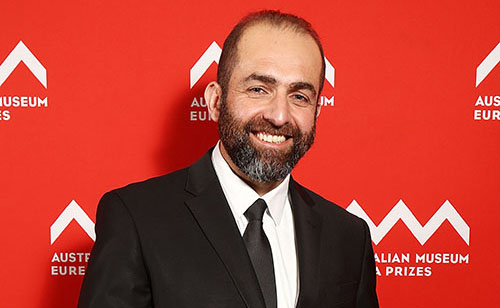
Manual Name : Professor Salah Sukkarieh
Manual Description : Professor of Robotics and Intelligent Systems
Manual Address :
Manual Addition Info Title :
Manual Addition Info Content :
Profile image : /content/dam/intranet/images/news-initiatives/news/2017/september/salah-eureka-hp.jpg
Manual Type : profile
_self
Auto Type : contact
Auto Addition Title :
Auto Addition Content :
Auto Name : true
Auto Position : true
Auto Profile image :
Auto Phone Number : false
Auto Mobile Number : false
Auto Email Address : false
Auto Address : false
UUID : 9af0a766-7c3b-49bd-bb46-9f2b572acb4e