
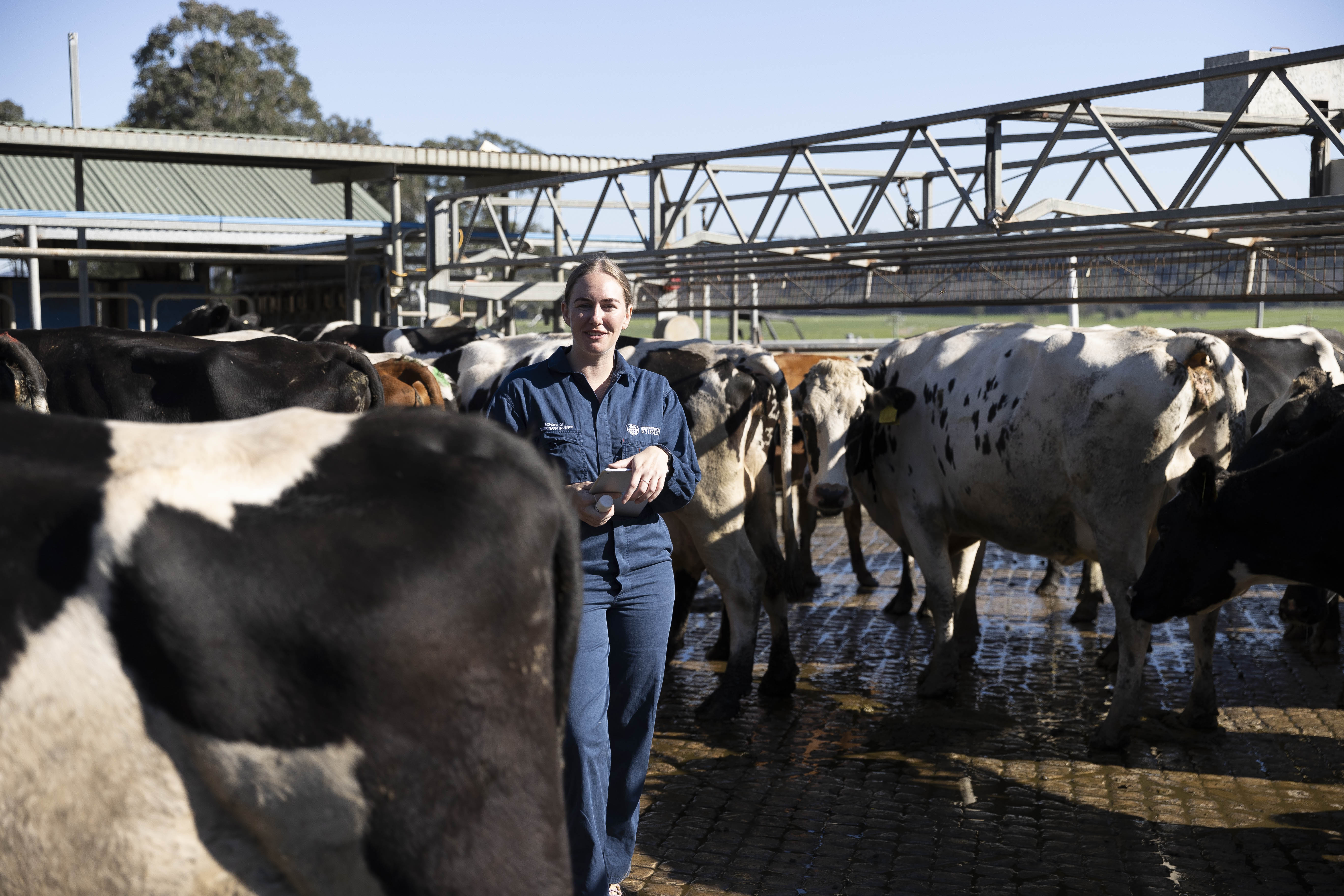
Bachelor of Agricultural Science

Solve the biggest problems facing our world with agricultural sciences.

Domestic student, 2027

Compare (0)

Why Bachelor of Agricultural Science?

Join the exciting world of agriculture by starting your journey at Australia's first university for agricultural science. Our three-year degree will build your skills and knowledge in areas such crop production, animal production, soil science and hydrology, food science and agricultural economics.

If you want to help meet the rising demand for efficient food production globally and learn the latest in agricultural science and technology, including using sensors, robotics, data analytics, and regenerative farming practices, this degree is for you.

Overview

Entry score

75.0 Selection rank

Fees

A$9,388*

This is the indicative annual student contribution amount (per calendar year), based on a full-time study load of 48 credit points. The degree requires 144 credit points in total. 

Estimate only. View complete fee details

Duration

3 years full-time
(Available part-time)
Not available to student visa holders.

Intake/s

Semester 1 - February

campus Location

This course is delivered across multiple locations:
The University of Sydney (Camperdown/Darlington campus)
- AND -
Camden Campus (Plant Breeding Institute)

Study mode

Face to face

Additional info

UAC Code :
513941
Credit points :
144
Total amount of credits points required to complete this course. All subjects have a credit point value to indicate their contribution towards completing the course.
BPAGRSCI1000

What you’ll study

The Bachelor of Agricultural Science is ideal for students who want to develop a broad and coherent understanding of agricultural science and its role in sustainable production and global food security.

You will study a range of subjects, including introductory agricultural science, biology, animal management, agronomy, agricultural economics and business, agricultural markets, statistics and data analysis, genetics, plant protection, biotechnology, and digital agriculture.

Alongside these core subjects, you will gain a competitive edge in the industry through one of eight cognate majors in areas such as environmental and agricultural economics, ecology and evolutionary biology, animal production, genetics and genomics, microbiology, plant science, food science, and soil science and hydrology. You will also apply your expertise to solve problems in interdisciplinary group project units.

Through our degree, you'll gain hands-on experience in the lab and the field and graduate job-ready to forge a rewarding career with real-world impact.

This course has cross-cutting knowledge themes of Profitability, Sustainability, Entrepreneurship, and Ethical Behaviour. It will equip you with the future-focused skills required for professional work in the agriculture sector.

The Honours year gives students an opportunity for research training, internships with leading agricultural companies and institutions, block-mode learning at the University's regional sites, and advanced coursework focussing on resilient and emerging agricultural systems in Australia.

Explore your options

Browse the various subject areas you can choose within this degree.

Major

A major is a sequence of units of study that offer specialised knowledge in a particular field.

Animal Production

Contemporary animal production aims to yield high quality products in ways that are efficient, sustainable and humane. 

Learn more

Ecology and Evolutionary Biology

About this major

Ecology and evolution are important concepts that underlie a broad range of the biological sciences. Ecology investigates the processes that govern the biological interactions between individuals and that operate on ecosystem scales. Evolution is a unifying theme that explains the patterns we observe in the natural world, ranging from genomes to the diversification of life through time.

The fields of Ecology and Evolution intersect at multiple levels and are critically relevant to real-world challenges, including wildlife conservation.

In this major you will learn about evolutionary and ecological processes and how these influence the population dynamics of animals, plants, and other organisms. This knowledge forms the basis for the effective management and conservation of biodiversity, ecosystems, and habitats.

Learn more

Food Science

About this major

Food is an integral part of our lives. Beyond providing essential nutrition and influencing health, food features strongly in our social and cultural systems, and is a major contributor to economic prosperity. Food and beverage manufacturing is the largest employing sector within manufacturing in Australia, and the importance of the food industry will grow as global food consumption increases with the population.

The Food Science major comprises foundational units in biology, chemistry, statistics; core intermediate units on principles of food science and biochemistry; and senior units in food processing, chemistry & biochemistry of foods, food technology & biotechnology, and product design & development.

The major provides you with fundamental knowledge and applied skills desirable for employment in the food industry. The interdisciplinary and applied nature of the major will also provide you with transferable skills that are complementary with many other fields of study in the life and environmental sciences.

Learn more

Genetics and Genomics

The Genetics and Genomics major will allow you to investigate a multitude of life forms and their biochemical, molecular and genetic interactions – from viruses, bacteria and protozoans to fungi, plants and animals, including humans.

Learn more

Microbiology

Microbiology teaches us about life forms that are too small to see with the naked eye. They are vital for life on Earth but can also cause huge problems as infectious disease agents, plant pathogens, contaminants of food and water and biofoulers.

A major in Microbiology introduces you to this tremendous diversity of function and form in the microbial world. You explore the impact of microbes on other life forms, look at their role in health and disease at the level of individuals, populations and ecosystems, and in particular their place in the nexus of human, animal and environmental inter-relationships.

You will investigate ways in which microbes are used to manufacture products and remediate polluted environments and explore microbial genetics and microbial life at the molecular level, with a particular emphasis on current research in Microbiology in our 3000-level units.

By progressing through the major students will learn advanced concepts and methods including molecular microbiology, systems biology, genomics, transcriptomics and proteomics, advanced microscopy techniques, genetic manipulation, microbial evolution, and the use of antimicrobials and antimicrobial resistance.


Learn more

Plant Science

Explore the fundamental biochemistry and physiology of plants

Learn more

Soil Science and Hydrology

About this major

Soil and water security are major human existential challenges to the planet and more so in Australia, being the driest continent with highly weathered soils.

The Soil Science and Hydrology major provides students with training in three key areas; soil, water and climate, and their links with functional, resilient and productive ecosystems.

Soil, water and climate define the physical constraints to ecosystems, and the interpretation of these along with their costs and benefits supports the development of policy and sustainable management strategies.

This knowledge will help secure our soil and water resources to maintain healthy, functional and productive ecosystems. We will explore the complex interaction between soil, water and climate, and the way we manage our landscapes. Ecosystems are considered across paddock to catchment scales and include all sectors from agriculture to forestry to mining to nature reserves.

This major has a strong emphasis on field-based learning through field schools and emphasis on field measurement and modelling through analysis of non-spatial and spatial data. Working with case studies and projects, you will identify and analyse real-world problems with the aim of identifying options to maintain the functionality of these interrelated systems. Students will develop generic skills in GIS, laboratory and data analysis that will enable students to contribute to water and soil security.

Learn more

Professional practice

Vaccination Requirements 

Q fever 

The University is committed to ensuring the safety and wellbeing of its students. 

Vaccination against Q fever (Coxiella burnetii) is an inherent requirement for students enrolling in this course.  These students are at a higher risk of exposure to Q fever (Coxiella burnetii) due to their frequent contact with animals and completion of compulsory learning activities in high-risk environments.  

Students must be vaccinated against Q fever before commencing the course or no later than census date.   Q fever vaccination is only available in Australia with the vaccination process taking three weeks to complete. 

Tetanus

Students are also responsible for ensuring their tetanus vaccination is valid and up to date.  

Learn more  

2027 tuition fees

AUD$9,388

This is the indicative annual student contribution amount (per calendar year), based on a full-time study load of 48 credit points. The degree requires 144 credit points in total. 

Your Fees Explained

This is an estimate

The indicative fees displayed are an estimate only.  The estimate is for a Commonwealth supported place for 1 year of full-time study, which is usually 48 credit points (also known as 1.0 EFTSL).
 
The actual fees you will pay in your first calendar year will depend on many factors including:  

1.    the calendar year in which you commence studying your current course
2. the intake in which you commence your studies
3. whether your course is eligible for special rates for particular units of study
4. the specific units of study in which you enrol; and 
5. the student contribution bands under which each unit of study sits.    

The most recently published calendar year of fees payable for a specific unit of study are available here.  If you have any questions, you can submit an enquiry. 
 
How the estimate has been calculated  
 
Generally, the estimate displayed on the course page is usually calculated based on one of two methods:   

1. if a course has the effective equivalent of at least 10 full-time students enrolled, the fee estimate is based on the most recent data showing the average amount those students actually paid; or  
2. for new courses or those with fewer students (where we don’t have enough data), the estimate is based on the typical cost of studying full-time in the main subject area of the course. 

Additional costs, fees and incidentals

For most courses, there are other costs in addition to the tuition and/or student contribution amount, such as the Student Services Amenities Fee. Some are significant and can include course-specific materials, tools, protected clothing and equipment. Other costs may include application fees and credit card surcharges.

Entry requirements

1

Qualifications

Mandatory for course entry

To be eligible for admission into one of our undergraduate degrees, you need to have completed a recognised qualification and meet the required entry score.

Find your qualification in the qualification dropdown below (organised by country). If your qualification isn’t listed, you can find the full list on the recognised qualifications page.

Find your qualification

entry score

75.0

Selection rank

ATAR + adjustment factors

All scores listed are a guide for admission and subject to change.

Didn’t meet the entry score? Explore admissions pathways

The entry scheme you are eligible for will depend on your circumstances. In some cases, an entry scheme might allow you to gain entry to a course with an ATAR lower than the cut-off point. Other schemes let you provide additional info to support your application – such as a creative portfolio or evidence of how your studies have been impacted.

Recognition of prior learning

Recognition of prior learning (RPL) is when your previous studies and/or work experience are recognised and counted towards your degree as credit.

By accepting credit, you may:

  • reduce your course duration
  • reduce your fees

What you can seek recognition for

  • Units of study taken at another university or higher education institution.
  • Approved qualifications from a higher education institution or certain vocational education and training institutions.
  • For certain postgraduate degrees, your relevant work experience.

Application process

You can apply for credit as part of your course application, or after you've accepted your offer.

2

Prerequisites

There are no prerequisites for this course.

3

Assumed knowledge

You are expected to have studied the following subjects in high school to succeed in this course:

  • Mathematics Standard
  • English Standard
4

Inherent requirements

Key consideration

Inherent requirements are the essential tasks and activities necessary to be able to achieve the core learning outcomes of a course.

Before applying, it is important for you to read and fully understand the inherent requirements for this course.

5

English Language Requirements

Mandatory for course entry

You may need to provide evidence of your English proficiency to study with us. Find out which requirements are applicable to you below:

Option 1
English language requirements

If English is your first language, you need to have citizenship or permanent long-term residency (minimum 10 years) and completed secondary or higher education (tertiary) studies in an English-speaking country recognised by the University.

List of recognised English-speaking countries

American Samoa, Australia, Bahamas, Barbados, Belize, Botswana, Canada (excluding Quebec), Fiji, Gambia, Ghana, Gibraltar, Guyana, Ireland, Jamaica, Kenya, Lesotho, Liberia, New Zealand, Nigeria, Papua New Guinea, Samoa, Singapore, Solomon Islands, South Africa, Tonga, Trinidad and Tobago, United Kingdom (including Northern Ireland), United States of America, Zambia, Zimbabwe.

Option 2
English is NOT my first language

If English is not your first language, you will need to provide proof of your English proficiency before you can commence your studies at the University.

You can do this either by demonstrating that you have completed specific secondary or tertiary qualifications, by taking an English language skills test, or by completing a relevant English language course at the University’s Centre for English Teaching.

IELTS score A minimum result of 6.5 overall and a minimum result of 6.0 in each band
TOEFL - IBT score A minimum result of 85 overall including a minimum result of 17 in Reading, Listening and Speaking and 19 in Writing
Pearsons Test of English A minimum result of 64 overall and a minimum result of 60 in each band

How to apply

Before applying

Before applying, it is important for you to read and fully understand the inherent requirements for the Bachelor of Agricultural Science.  

These requirements include, but are not limited to, physical fitness and ability to handle a range of large and small animals; required vaccinations (specifically Q fever); and effective written communication skills. 

All domestic students need to apply through the Universities Admissions Centre (UAC).

Step 1:Documents you'll need

If you're an Australian Year 12 student UAC can usually obtain your results and ATAR from the relevant state education authorities.

For a full list of documents required, visit the UAC website .

Step 2:Key dates

Applying for Semester 1 (February)?

  • The University makes most of its Semester 1 offers through UAC's December Round 2.
  • It does not participate in every UAC offer round and makes limited or no offers before December Round 2. 
  • Application close for December Round 2: Applications typically close in late November.
  • Offers released for December Round 2: Offers are typically released in late December.
  • After December Round 2, some courses may be full and stop making offers.
  • Course vacancies will be available on the UAC website after January Round 1 offers are released.


Applying for Semester 2 (August)?

The University typically participates in selected UAC offer rounds between May and July. Offer rounds and dates may vary each year.


We strongly encourage you to visit the UAC website for a comprehensive list of key dates, including December Round 2 offers.

Step 3:Apply via UAC

To maximise your chances of receiving an offer from the University of Sydney, make sure to list your most desired degree at the University of Sydney as your first preference in your UAC application.

Step 4:After you apply

When the outcome of your application is available, you’ll receive an email from UAC. You will then receive an email from us with instructions on how to accept your offer.

Accepting your offer

Stay informed

Key dates, event invites and more - we’ll keep you in the loop.