The Centre for Disability Research and Policy's (CDRP) research responds and adapts to new and emerging disability policy and practice concerns, to maintain ongoing relevance to society. It is community-driven, co-led, co-designed and co-produced with people with lived experience of disability.
Our research is articulated around research streams, evolved in line with current pressing policy and practice issues, and cross-cutting themes, representing specific areas of focus present throughout our centre’s work.
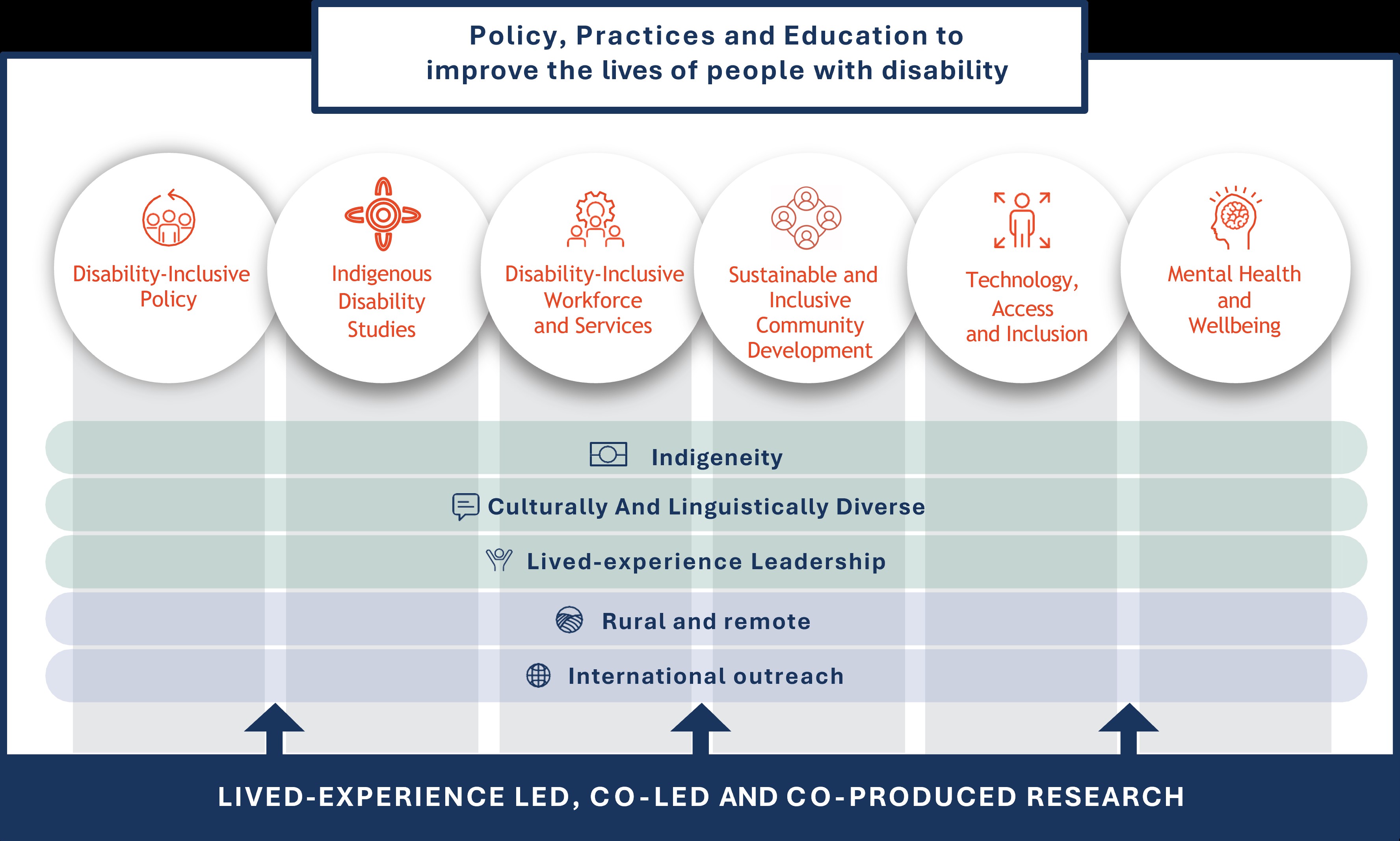
Our research is guided by our Strategy Plan. Download and read the Strategy Plan here: Centre for Disability Research and Policy Strategy Plan (pdf, 10.5 MB)
Policies often don't work well for people with disability because they're created without understanding their needs and interests. This research stream studies how to co-develop policies that reflect what's important to people with disability. Getting people with disability, their supporters, and families involved in co-developing policy is key to creating useful and relevant policies.
However, inclusive disability policy development rarely happens smoothly and is often tokenistic. We are interested in how research, co-designed by teams with and without disability, can use knowledge and lived experience of disability to critique policy making and create better disability policies. We study how policy actions are put into practice through services and how people with disability experience them. To do so we use sophisticated quantitative and qualitative approaches to monitor and evaluate the ways that both mainstream and disability specific policy impacts the lives of people with disability and is relevant to their needs. Read more about our research with the Australian Research Council (ARC) Industry Laureate Project, which focuses on supports for people with serious mental ill-health (also called psychosocial disability) in and beyond the National Disability Insurance Scheme (NDIS).
We take a critical and practical approach to understanding how experiential knowledge, or expertise gained from lived experience of disability, influences policy. We actively support including lived experience in policy development and examine the evidence-based barriers and measures that respectively prevent and enable effective and meaningful participation in policy change.
Current work in this stream focuses on:
- The involvement of experts by experience in the development of key federal government policies such as the NDIS.
- Theoretical research on what experiential knowledge is and who has it, including what experts by experience working in both policy advocacy and internal government roles.
- How processes of policy transform ideas that come from people with disability into policy actions.
- Using research to influence policy making in key areas, including the NDIS, employment policy and education policy.
- Developing an evidence-based mental health policy model for Trans and Gender Diverse employees with psychosocial disability (Key Researchers: Dr Damian Mellifont and KC Stegley).
- Leading the development of the Health Equity for Persons with Disabilities Global Health Policy and System Research Agenda in collaboration with WHO Geneva (Key Researchers: Ass/Prof. Kim Bulkeley and Prof EM. Gwynnyth Llewellyn).
- Investigating ways in which evidence developed with people with disability is aligned with policy opportunities for system change (Key Researchers: Prof EM. Gwynnyth Llewellyn and Dr Jodie Bailie).
- Providing research evidenced advice to government to reform the operation of the NDIS and associated community-based supports for people with severe mental illness. (Key Researchers: Prof. Jen Smith-Merry, Dr Jade Chang, Dr Joel Hollier, Dr Firew Bobo, Dr Ivy Yen).
- Addressing serious deficits in the operation of the National Disability Insurance Scheme (NDIS) for one of its largest participant groups: people with psychosocial disability (learn more about this project here).
The Indigenous Disability Studies stream governs and fosters the growth of Indigenous disability-led research at a national and global level. The stream engages with Indigenous peoples with disability through research grounded in traditional Indigenous methodologies, cultures, languages - including oral and sign languages - standpoints and lores. It seeks to decolonise and Indigenise disability scholarship by placing Indigenous peoples at the forefront of research about their lives, families and communities.
Through Indigenous-led and community-engaged research, the stream advances the health, wellbeing, inclusion and self-determination of Aboriginal and Torres Strait Islander people with disability. The stream contributes to culturally safe disability policy, practice and workforce development, while promoting Indigenous knowledge systems and strengthening local, national and international collaborations in disability research.
More information and abstract submission: Call for Contributions: Global Indigenous Disability Knowledge Systems
People with disability need a knowledgeable, diverse, and skilled workforce and effective services to be truly included and participate in society. Changes in laws and policies, both in Australia and overseas, mean we need to rethink how we build this workforce to make the most of these positive changes.
This research stream looks at new ways to train people and develop their skills, different ways of providing services, and how to help communities better support and work with people with disability in everyday life.
We focus particularly on groups of people with disability who don't always get the support they need, especially those in rural and remote areas, and Aboriginal and Torres Strait Islander communities.
Current work in this stream includes:
Even though society is making progress, people with disability still face big challenges in being fully included in their communities. They often experience discrimination in two harmful forms: first, they are overprotected, which can stop them from growing and being independent, and second, they are neglected and their needs ignored.
Our research stream promotes disability-inclusive community development designed to confront and eliminate discrimination. We go beyond just filling gaps and fixing problems. Our initiatives empower transformative change that directly influences practices and policies for substantial, lasting impacts.
This program aims to reshape traditional approaches and foster environments where safety and empowerment go hand in hand. It ensures that protective measures support, rather than restrict, the inclusion and autonomy of people with disability. Through this balanced approach, we strive to enhance the quality of life and ensure equitable participation for all members of the community.
Collaborating 4 Inclusion
The Collaborating 4 Inclusion partnership research led by Professor Michelle Villeneuve tackles the problem of how to develop shared responsibility between local government, people with disability and the services that support them in emergencies. The team work to address persistent policy and practice questions about local leadership and emergency planning to positively impact safety and wellbeing outcomes for people with disability, including:
The Collaborating 4 Inclusion vision is to position Australia as a world leader in Disability Inclusive Disaster Risk Reduction (DIDRR).
We work to:
Accessibility is a basic human right. Everyone, including people with disability, should have the same opportunities to participate in all aspects of life – education, employment, social activities, and more.
This research stream brings together experts in disability and inclusion from different fields like communication, design, and technology. We develop technology for everyone, work to create inclusive policies, collaborate with researchers from different areas, provide education and training, and explore new research areas like the impact of artificial intelligence.
Current projects in this stream include:
There is no health without mental health. Disability can be a barrier to living a personally meaningful and valued life of choice. It is something faced by many people living with a mental illness. These barriers to participation and inclusion originate from both mental illnesses and society.
The Mental Health and Wellbeing stream is focused on optimising meaning, purpose and contributions of people living with mental illness as well as promoting the mental health and wellbeing of all people experiencing disability.
We critically examine and influence policies and initiatives to enhance participation and inclusion. Our work also amplifies the voice of service users and providers in the policy and research discourse and implementation.
Our stream builds international partnerships with service users, service providers, researchers, government and community organisations.
Current projects:
Our work is shaped by and incorporates the following cross-cutting themes, with the aspiration to see each of these areas represented in every research stream.
The disability rights movement’s foundational principle, “nothing about us without us”, recognises that people with disability are experts on their own needs and well-being. They must have a primary voice in the social services and developments that impact their lives.
The CDRP is committed to disability lived experience led research. At a minimum, all of our research is actively codesigned with people with disability and their supporters. Our strategic direction focuses on:
We actively pursue these aims by appointing people with lived experience leadership positions within the Centre and in our research projects. We also collaborate with the University of Sydney to promote lived experience teaching.
Current disability research and policy often disenfranchise Indigenous people with disabilities, who experience higher rates of disability due to colonisation. Racism and ableism intersect, leading to exclusion, violence, and neglect of First Nations people with disabilities.
The CDRP treats indigeneity as a cross-cutting theme, recognising the disproportionate mistreatment of Indigenous people with disabilities. We are committed to decolonising disability research by challenging Western perspectives and partnering with Indigenous communities.
Our work ensures that research translates into meaningful policy outcomes, and we actively build partnerships with scholars and Indigenous communities worldwide.
People with disability come from diverse cultural and linguistic backgrounds. Our work recognises that people understand and experience disability differently, according to their culture, language, ethnicity, religion, and other social factors. We are committed to research that is inclusive, culturally responsive, and accessible to diverse communities.
We acknowledge that the Western ways of thinking and doing research, including in disability studies, can exclude and alienate CALD people. Our research actively challenges these biases and seeks to understand the unique experiences, needs, and strengths of CALD communities. We do this by centring the voices and perspectives of people from diverse backgrounds, utilising culturally appropriate research methods, and addressing language barriers through translation and interpretation services.
Our research emphasises the importance of understanding and addressing the needs of people with disabilities at all stages of life. Our work spans early childhood, adolescence, adulthood, and aging, recognising that each life stage presents unique challenges and opportunities for individuals with disabilities.
Key outcomes include the development of best practices for early childhood supports, ensuring that children with disabilities receive the necessary interventions to thrive. Our research also focuses on the transition to adulthood, exploring pathways to employment, higher education, and independent living. For adults, we investigate strategies to enhance social inclusion, health, and wellbeing, while addressing the specific needs of aging individuals with disabilities.
By adopting a lifespan approach, the CDRP aims to create a comprehensive understanding of the experiences and needs of people with disabilities throughout their lives. This approach informs policy and practice, ensuring that supports and services are responsive to the evolving needs of individuals with disabilities at every stage of life.
Our research highlights the significant challenges faced by people with disabilities living in rural and remote areas. These individuals often encounter barriers to accessing services, information, and specialists, which are exacerbated by geographic isolation. Our research aims to address these inequities by developing innovative solutions and policy recommendations to improve service delivery in these regions.
Key outcomes include the development of telepractice models to enhance access to healthcare and support services, and the implementation of culturally safe practices for Indigenous communities. We also focus on building local capacity through community partnerships and training programs, ensuring that people with disabilities in rural and remote areas receive the support they need.
By actively engaging with local communities and stakeholders, the CDRP ensures that our research translates into practical, impactful outcomes that improve the lives of people with disabilities in rural and remote Australia.
We are deeply committed to improving the lives of people with disabilities globally, recognising the significant exclusion, maltreatment, and poorer health outcomes they face, particularly in countries with lower economic capacity.
Our international outreach efforts focus on sharing knowledge, building capacity, and fostering collaboration across borders to advance disability rights and inclusion worldwide.
Key outcomes include collaborative research projects with international partners, such as the Sydney Southeast Asia Centre Timor Leste Field School. We engage in knowledge exchange through conferences, workshops, and publications, sharing our findings and best practices with global partners.
Additionally, we support the development of disability research capacity in other countries by mentoring international PhD students and overseeing collaborative project. Our advocacy efforts involve working with international organizations to influence policy and promote the rights of people with disabilities globally. These initiatives aim to create meaningful and lasting improvements in the lives of people with disabilities around the world, contributing to the global movement for disability rights and inclusion.
Mailing address
Susan Wakil Health Building,
University of Sydney, Camperdown,
NSW 2006
