
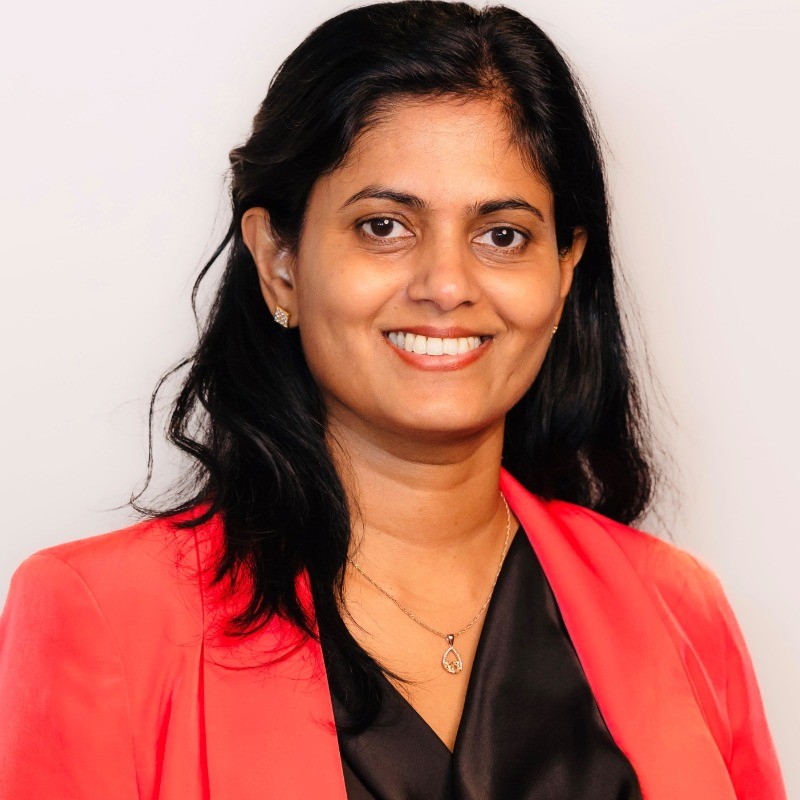
As the research lead on a groundbreaking environmental monitoring project in partnership with industry, Dr Mehala Balamurali has developed an AI-driven system to detect invasive species across vast post-mining landscapes.
Her work is transforming the mining industry, and has earned her widespread recognition including the Outstanding Engineer Award in the Women of Colour in STEM Awards 2025, a place as a finalist in the Women in AI Asia-Pacific Awards 2024, and regular invitations to speak at global forums.
She discusses her current project, which involves integrating high-resolution drone imagery with satellite-based extrapolation to map vegetation across thousands of hectares of mined land.
“This isn’t just a technology,” Mehala explains. “It’s a tool that empowers non-technical teams to make faster, evidence-based decisions for land rehabilitation, supporting sustainability and ESG [environmental, social and governance] goals.”
URL
embed-0dba693246
Dr Mehala Balamurali discusses her work that led to recognition with the Outstanding Engineer Award in the Women of Colour in STEM Awards 2025
Making complex AI practical
The application of sophisticated technological solutions to real-world problems is a theme of all Mehala’s research, she says. “The common thread through all my work is the use of data-driven and AI-enabled methods to understand, predict and optimise real-world processes.
“Earlier in my career, I co-developed a patented technique for geological modelling that uses advanced data clustering methods to group similar mineral deposits, which helps create more accurate 3D models of ore deposits," Mehala explains."In simple terms, it’s like sorting puzzle pieces by shape and colour before assembling the picture, making it easy to understand what’s underground. This innovation streamlined mine planning and set a new standard for efficiency.
“The real challenge in all my work is making complex AI practical. I tackle data scarcity and filed constraints by designing adaptive protocols and collaborating closely with industry teams, ensuring our tools work where they are needed most – on the ground.”
All of Mehala’s work sits at the intersection of AI and engineering, where she develops computational frameworks for modelling complex systems across disciplines, ultimately resulting in the broadest possible real-world impacts.
“I aim to create AI and engineering methodologies that not only deliver domain-specific insights but advance the underlying approaches to decision making, uncertainty modelling and data interpretation,” she explains. “My goal is to ensure that each framework developed contributes both to fundamental AI research and to practical, scalable impact in engineering and environmental systems.”
This isn’t just a technology. It’s a tool that empowers non-technical teams to make faster, evidence-based decisions for land rehabilitation, supporting sustainability and ESG [environmental, social and governance] goals.
Dr Mehala Balamurali
Motivated by tangible impact
It is this opportunity to see her research translate into meaningful, real-world impact that motivates Mehala.
“What I find most rewarding is when complex AI models and data-driven methods evolve into practical solutions that are validated through industry collaboration and field application,” she says.
“These outcomes demonstrate the true value of research by creating tools, insights and frameworks that address tangible environmental and engineering challenges. It is deeply fulfilling to see how rigorous scientific inquiry can influence practice, guide decision making, and contribute to more sustainable and responsible ways of managing our natural and built environments.”
Mentoring students is another of the most fulfilling aspects of her work, she says. She guides a wide range of projects that see students apply AI across diverse areas. Many are developed with industry partners, allowing students to work on real-world data challenges and contribute to practical solutions.
It is deeply fulfilling to see how rigorous scientific inquiry can influence practice, guide decision making, and contribute to more sustainable and responsible ways of managing our natural and built environments.
Dr Mehala Balamurali
A supportive and collaborative work environment
Finding a workplace that shares her research values has been fundamental to Mehala’s ongoing growth and success as a researcher.
“The University of Sydney provides an exceptional environment for interdisciplinary research and innovation,” she observes.
“My experience within the Faculty of Engineering, too, has been genuinely positive. I’ve found it to be a supportive environment that values expertise, collaboration and initiative. I benefit from access to advanced computing infrastructure, collaborative research hubs, and a culture that actively supports cross-faculty partnerships. This enables me to work at the intersection of AI, environmental monitoring and biomedical applications with colleagues from science, health and engineering disciplines. I am also particularly supported with opportunities to engage with external partners through industry-linked initiatives and research centres, where ideas are tested and validated in real-world contexts.
“This balance between academic freedom, collaborative mentorship and translational impact is what makes the University of Sydney such an inspiring place to conduct research that contributes meaningfully to both scientific knowledge and societal outcomes.”
The University of Sydney provides an exceptional environment for interdisciplinary research and innovation. This balance between academic freedom, collaborative mentorship and translational impact is what makes it such an inspiring place to conduct research that contributes meaningfully to both scientific knowledge and societal outcomes.
Dr Mehala Balamurali
Thriving as a woman in a traditionally male-dominated field
While engineering has traditionally been a male-dominated field, Mehala says she has never viewed this as a barrier to doing or leading meaningful work.
“Every person is different, and all ideas matter. The qualities needed for engineering are not male or female. I believe diversity in engineering, including gender diversity, naturally brings a broader range of perspectives and problem-solving approaches. In collaborative environments, this diversity of thought fosters innovation and more responsible engineering practices, which is ultimately what strengthens our discipline and its real-world impact.
“Continued efforts to strengthen representation and diversity remain important, however, so that the next generation can see that excellence in engineering has no gender or cultural boundary.”
As for her own contribution, on this Mehala is clear.
“I’m humbled and honoured to contribute to STEM. My mission is to mentor the next generation, especially young women and minorities, and foster a community where we learn, grow and lead together. I want to inspire others to dream big and shape a sustainable future.”
Manual Name : Dr Mehala Balamurali
Manual Description : Senior Research Fellow, Australian Centre for Robotics SEMCAN- Network and Engagement Lead
Manual Address :
Manual Addition Info Title :
Manual Addition Info Content :
Profile image : /content/dam/corporate/images/faculty-of-engineering-and-information-technologies/faculty-our-people/mehala-balamurali.jpg
Manual Type : profile
_self
Auto Type : contact
Auto Addition Title :
Auto Addition Content :
Auto Name : true
Auto Position : true
Auto Profile image :
Auto Phone Number : false
Auto Mobile Number : true
Auto Email Address : true
Auto Address : false
UUID :