
Seventeen at Belvoir – a brilliant theatrical event with a happy, hetero ending
"As a gay man watching the play's ending, I felt I'd seen this story too many times to feel part of its investments in the future," writes Dr Huw Griffiths.
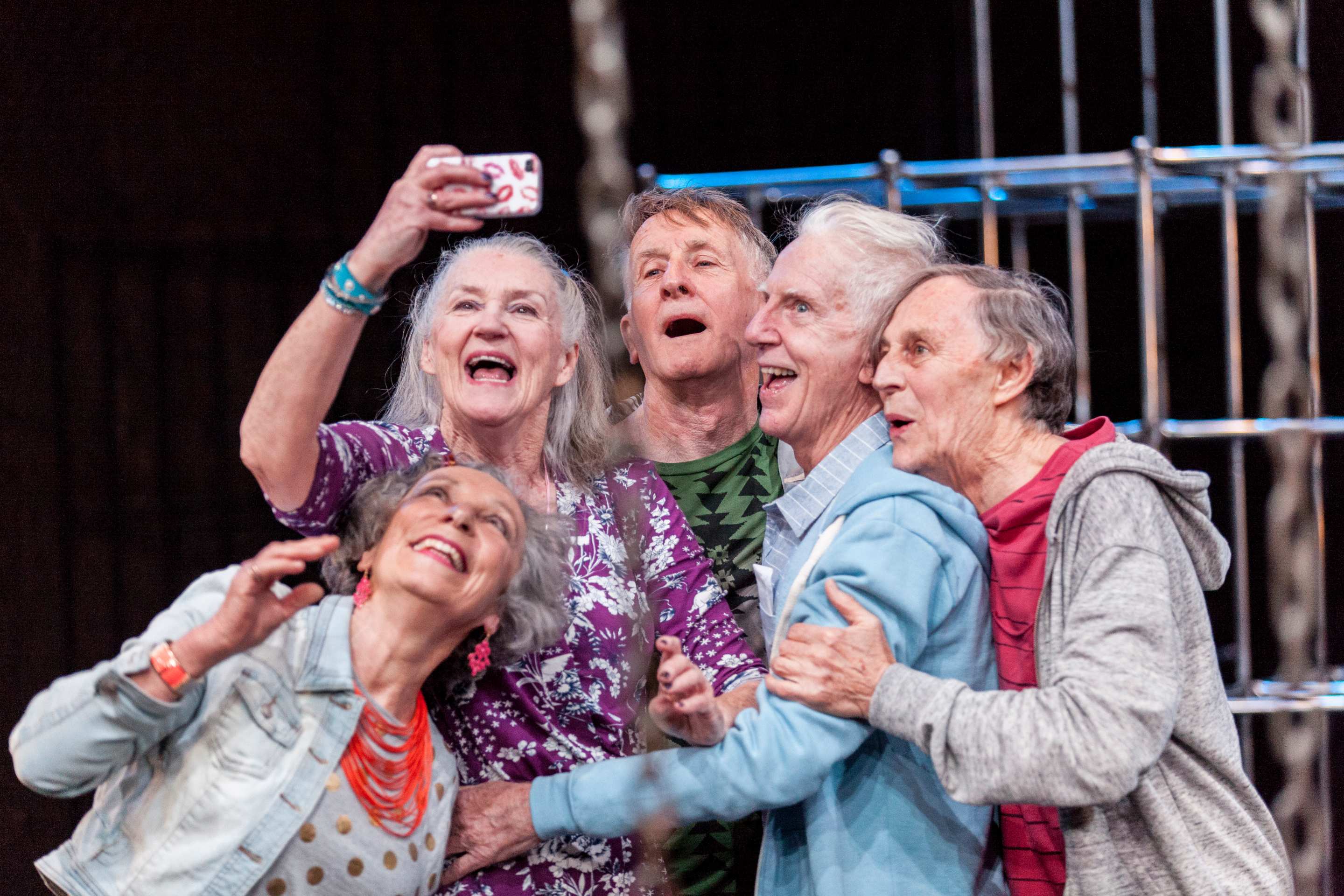
Anna Volska, Maggie Dence, John Gaden, Peter Carroll and Barry Otto in Seventeen. Image: Brett Boardman/Belvoir St.
Our experience of plays is always profoundly affected by how they end: comedy or tragedy, death or marriage, hope or despair. My response to Matthew Whittet’s Seventeen (directed by Anne-Louise Sarks at Sydney’s Belvoir Theatre), a play that thinks hard about how our endings are related to our beginnings, is no exception. And that means this review contains spoilers. Sorry.
The motivating idea behind Seventeen is a brilliant one: actors in their seventies play 17-year-olds on their last day of school, poised on the brink of an adulthood which they can barely comprehend. The canny trick of using older actors to perform these roles adds a wonderfully exuberant humour.
The cast dancing to Taylor Swift’s Shake it Off – which would have been cut if the pop megastar hadn’t given last-minute permission for the song’s use – is one of the most joy-filled moments on stage I have ever seen.
But it also lends poignancy and a searching irony. As they inhabit the gauche attitudes and awkward physicalities of late adolescence, the questions posed by the bodies of these actors are potentially devastating: which of their dreams will come true? Will their hopes be fulfilled?
If there is despair, will the future bring consolations? What happens to love? As awareness of mortality creeps into our lives, what will have been important to us?
For all its consideration of the relationship between childhood and future lives, this is a conservative play. And, as a gay man watching the play’s ending, I felt I’d seen this story too many times to feel part of its investments in the future. Here’s what happens:
Half way through the play there’s a touching scene between the characters of Tom and Sue. Sue is going out with Tom’s best friend, Mike, but Tom confesses his love for her by telling her about a dream he’s had in which they grow old together, surrounded by grandchildren.
Played by Peter Carroll and Maggie Dence, it’s a touching pause in a night of frantic teenage activities. The final scene echoes this moment as Tom and Sue sit on swings together (the play is set in a suburban playground), flying upwards towards a possible future in which Tom’s dream could come true.
Throughout the play, Mike is the character most resistant to the idea of growing up. He wants to hold on to the last remnants of childhood before they are cruelly taken away from him. He also, on finding out that Sue has been pashing Tom, admits that it is Tom that he has loved all along.
This provokes a tender moment in which Mike (played by the endlessly charming John Gaden) recalls, for Tom, their first meeting as much younger kids when Tom had taken him under his wing. But there is no reconciliation between these friends. Mike, perhaps rightly seeing no future in maintaining a friendship that has gone wrong, hurries himself off stage.
I wanted to follow him. I wanted to have a stake in his future and not in Tom and Sue’s future grandchildren.
So, it’s that old story: straight people have a claim on the future. Gay people don’t. I had sat through this joyous play, laughing and crying with these characters, only to be told the same thing I’ve been told since I was a kid.
Why is this story so persistent?
Freud, in the early 20th century, allied homosexuality to immaturity, claiming that it is marked by an inability to grow up, to make properly adult sexual attachments. “I don’t want it all to change yet,” Mike says, early in Seventeen and wishes that he could “freeze time so nothing ever changes”.
Freud’s theories imply, and depend upon, a narrative arc that is much older than psychoanalysis, as old as comic drama itself: one in which only heterosexual marriage is synonymous with a happy ending.
Shakespeare’s comedies are classic examples. At the end of Twelfth Night, as Sebastian is due to marry Olivia, what has happened to his friend Antonio, the dashing pirate who, like Mike, has declared his love and will risk death to help his beloved companion?
I do adore thee so
That danger shall seem sport
We don’t know because, just like Mike, Antonio doesn’t get any lines in the final scene and is excluded from the play’s investment in that universal happy ending: straight marriage with kids.
If we think – optimistically – that Australia is on the road to joining much of the rest of the world and legislating to allow same-sex marriage, then I wonder what difference that makes to 17-year-olds considering their futures? I also wonder what difference that might make to our understanding of “happy endings” too?
Queer theorists such as Lee Edelman, Annamarie Jagose, and Jack Halberstam have, in the last decade, reclaimed the idea of a non-productive future as their own, our own, resisting the telos (happy ending) of growing up/ marriage/ reproduction. In No Future: Queer Theory and the Death Drive (2014), Edelman calls this:
An insistence on the negativity that pierces the fantasy screen of futurity.
Perhaps, when he was bunking off school, Mike was secretly reading No Future?
So, if I run off-stage with Mike, “shaking off” the straight swinging couple, we’ll both run into Antonio the pirate and together we’ll dream up future happy endings. I don’t know what they’ll be yet, because nobody seems to want to tell those stories.
Seventeen is at Belvoir Theatre until September 13. Details here
First published on The Conversation.
Related articles
Surge in flu this winter
People suffering severe flu this winter should seek medical treatment as soon as possible.

Dementia tsunami: Alzheimer's and other dementias to triple by 2050
Governments need to take action on delaying the onset of Alzheimer's disease and other dementias, argues Associate Professor Lesley Russell.
Legalising medicinal cannabis would create $100 million industry
Analysis from the University of Sydney Business School has found that legalising medicinal cannabis in Australia could create a new industry worth more than $100 million per year.
Ready, set, Rio: Sydney cohort heads to the Games
As more than 3.5 billion people around the world turn their sights towards Rio this week, 30 athletes from our community are getting ready to take their place on the globe’s biggest sporting stage.
Science student makes greatest self-discovery at the University
'Leave your comfort zone' is Kevin Gatdula’s motto in life. With an emphasis on continual personal development, the 20-year-old Bachelor of Commerce and Science student believes that this is the only way to cultivate a journey of personal growth.
Learning never stops - but it starts at Open Day
Like so many high school students in their final year, Denise Ong had a head full of questions. Little did she know at the time that one question she asked would later lead to a major turning point in her story.
Australian study wants your view on personal genomic testing
Do you want to know about your genetic information? Would you share it?
Sydney at Rio: two silver and a bronze add to our tally
In a blockbuster first week at Rio 2016 our athletes have continued to excel winning two silver and a bronze to add to Chloe Dalton's gold in the Rugby Sevens. Our total would see us sitting at 35th on the country tally rankings – ahead of Ireland, Slovenia and Romania.
Future research stars supported under new Sydney fellowship
The first cohort of fellows of the University's new Sydney Research Accelerator (SOAR) program has been announced.
Sydney tops the state for graduate employability
The University of Sydney has been ranked number one in New South Wales and 49 in the world in the most recent Times Higher Education Global Employability University Rankings.